
"Our ChatGPT Ads aren't converting." If you only measure what happens with the first click, you're probably saying that yourself. We've run ChatGPT ads for B2B clients for about six weeks, and what people did after the click taught us more. Judging a channel built for conversational research by last-click conversions is like grading a trade show by how many attendees filled out a form before they left the booth.
The harder question is whether the people who click stick around, come back, and eventually start a buying conversation. That question matters more for industrial vendors selling six-figure engagements over months-long cycles than it does for ecommerce brands tracking same-session purchases.
Key points
- ChatGPT ads show click-through rates around 0.73% compared to a 6.64% average for search ads, and a Kaiser and Schulze study found paid ChatGPT visits converted at 0.37% versus 1.17% for paid Google search visits, with 73 of 87 advertisers recording no paid ChatGPT transaction at all.
- Only Free and Go users see ChatGPT ads while Plus, Business and Enterprise seat holders see none, so you reach individual researchers, not whole buying groups at companies that pay for enterprise access.
- John Dawes at the Ehrenberg-Bass Institute estimates that most business clients are not in the market for many goods and services at any one time, which suggests most people clicking your ChatGPT ad are still researching before they're ready to buy even if they have questions your company can answer.
- Return visits from the same companies, direct and branded search traffic, and content engagement on retargeting matter more than first-click conversions because they show whether the initial click created enough interest to bring someone back and start building familiarity during a months-long buying cycle.
- Before testing ChatGPT ads you need UTM tags on every URL, visitor identification tools to see which companies visit your site, content worth coming back for, a retargeting channel outside ChatGPT since remarketing audiences need substantial matched users, and a process for follow-up when target accounts appear.
- A test makes sense if you already run paid campaigns on Google or LinkedIn that cover demand-capture needs and have the required infrastructure, and a small budget over 6 to 8 weeks will show you whether traffic quality matches your target accounts and whether return visits materialize.
What is ChatGPT ads?
ChatGPT ads are sponsored placements that appear inside ChatGPT conversations. When a user asks a question that matches an advertiser's targeting, an ad can appear alongside or after the AI-generated response.
OpenAI has been building out the ad product quickly.
According to Channel Insider, ChatGPT Ads passed a $1 billion annualized run rate in under 200 days. That's OpenAI's revenue annualized from a single month, not a measure of what advertisers got back. On October 5, 2026, OpenAI added a visual ad format, conversion integrations with Hightouch, Tealium and LiveRamp, configurable click-through windows, and a one-day view-through window.
Who actually sees the ads
Only Free and Go users see ads.
According to a Similarweb FAQ on ChatGPT ad performance, Business and Enterprise seat holders see none.
For B2B, that decides who you can reach. The operations manager at a mid-size distributor researching ERP options on a free ChatGPT account will see your ad, and the IT director whose company pays for ChatGPT Enterprise will not.
So you're reaching individual researchers rather than entire buying groups, and whether that's a problem depends on what you do after the click.
ChatGPT ads performance: the first-click data is bad
Click-through and conversion rates
Similarweb reports a US ChatGPT ad CTR of 0.73% all-time, while LocaliQ's 2026 benchmarks put the average search ad CTR at 6.64% across Google and Microsoft Ads.
The CTR definitions differ between platforms, but the gap is large.
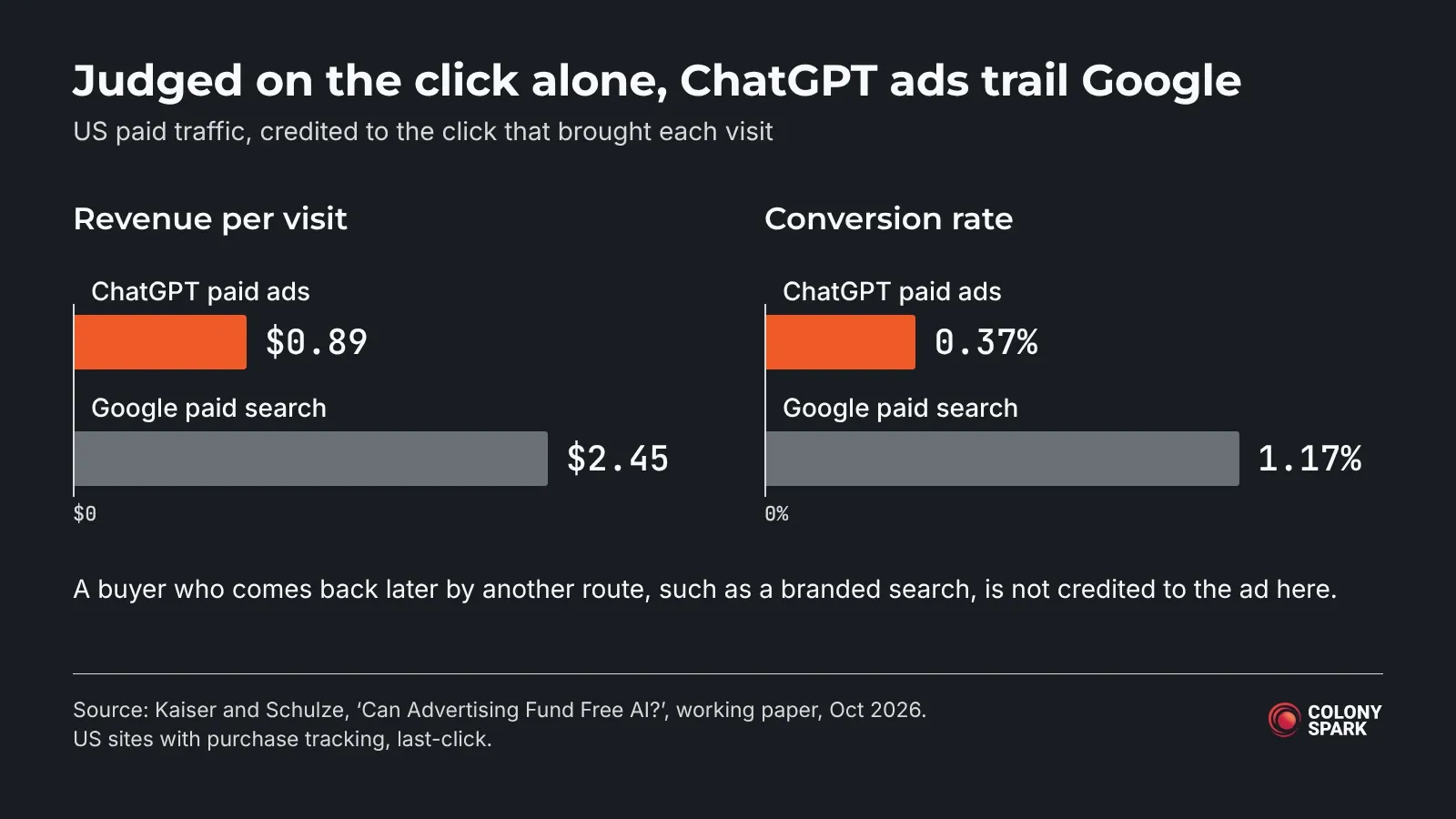
A Kaiser and Schulze working paper from WU Vienna and Frankfurt School of Finance, reported by PPC Land, found that in US traffic a paid ChatGPT visit generated $0.89 in revenue versus $2.45 for a paid Google search visit, and converted at 0.37% compared to 1.17%.
Of 87 advertisers buying both channels, 73 recorded no paid ChatGPT transaction at all. Those sales were concentrated: 14 sites carried all 570 transactions, and one advertiser held 66% of purchases.
That same paper matched 305 advertisers to non-advertisers over 12 weeks and found no detectable lift in direct, organic search, or paid search traffic. The study design could only rule out lifts of roughly 40 to 50% or more, so smaller effects might exist but weren't visible.
The revenue and conversion figures come from online shops and credit only the click that brought each visit. They tell you what happened in the same session.
B2B-specific test results
Two B2B pilots tell a similar story on first-click conversions.
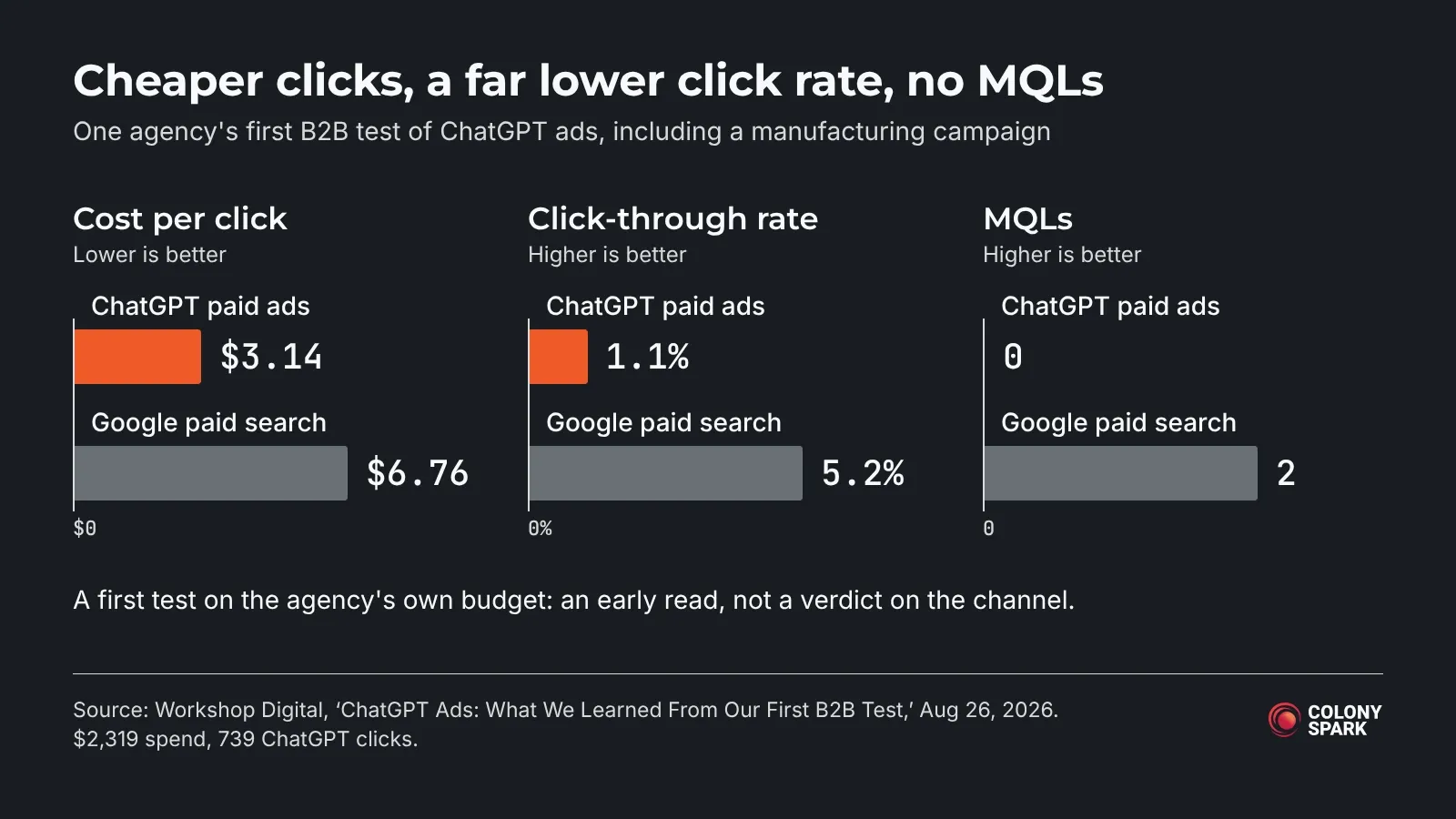
Workshop Digital spent $2,319 on ChatGPT ads, generating 739 clicks at a 1.1% CTR and $3.14 CPC, and reported no qualified lead, including from a manufacturing campaign.
Windmill Strategy ran an industrial and manufacturing pilot that produced CTRs around two-thirds of one percent, CPCs about a third of their Google search CPCs, and all new users with no tracked conversion in the first month.
There are also tracking concerns. As MediaPost reported via Yahoo Finance, one agency saw OpenAI report 57 clicks while Google Analytics showed fewer than 20 visits. Another agency described the campaign as "more of a display channel."
OpenAI's counter-argument
OpenAI argues that people use ChatGPT to work through a decision, so clicking an ad is often not their next step.
They've cited a WorkMagic geo-lift study estimating that one consumer brand (Dose) saw 2.3x more incremental orders than last-click captured.
That's vendor-selected and consumer, but it points to a real measurement gap. You need your own evidence before you believe it applies to your business.
What we learned from ChatGPT ads for B2B
We've been running these ads for some of our clients at Colony Spark for about six weeks.
We're paying more attention to what people do after the click than to the click itself.
How we're running it
We use RB2B for website visitor identification, which gives us clues about which companies may be visiting but never the reason for the visit. Companies that look like a fit get retargeted with content. Then we watch for them to come back. Six weeks is too short to tie any of this to closed deals, so you won't find client numbers here.
Return visits matter more than first visits
We're watching return visits more closely than first visits or demo requests, because a return visit shows the first click created enough interest to bring someone back.
The traffic is a mix. Some companies look like a fit for our clients, and plenty don't.
But a company looking like a fit doesn't tell you whether anyone there is ready to buy.
The out-of-market reality
John Dawes at the Ehrenberg-Bass Institute, writing for the LinkedIn B2B Institute, put it this way: most business clients are not in the market for many goods and services at any one time.
The figure behind that "most" is "up to 95%". Applied to our clients' ChatGPT ad traffic, that means roughly 95% of visitors aren't shopping for a provider today and are researching well before they're ready to buy. It's a rule of thumb, not a number we counted, and Dawes says the figure "is not meant to be a precise rule." They might still have a question your company can answer or a decision they're trying to understand.
Dawes also writes that when buyers do search, they strongly prefer brands they're familiar with. Our follow-up after the first click is built around that.
The job after the click
For example, say an operations manager at a regional distributor asks ChatGPT how other distributors track inventory across several warehouses, clicks an ERP partner's ad, reads one page and leaves. That distributor is on the partner's target list. Nobody there is shopping for an ERP partner this quarter, but the manager has a real question about multi-warehouse inventory. An article on exactly that question, shown to the distributor's people as a retargeting ad, gives the manager a reason to come back. If the company comes back weeks later by searching the partner's name, that's our signal.
We're seeing companies like that engage with the content and come back to the site through direct traffic or, most likely, branded search, though we can't yet say the ad caused it.
When they come back, we connect with them on LinkedIn. One client also invites them to its LinkedIn Lives and webinars.
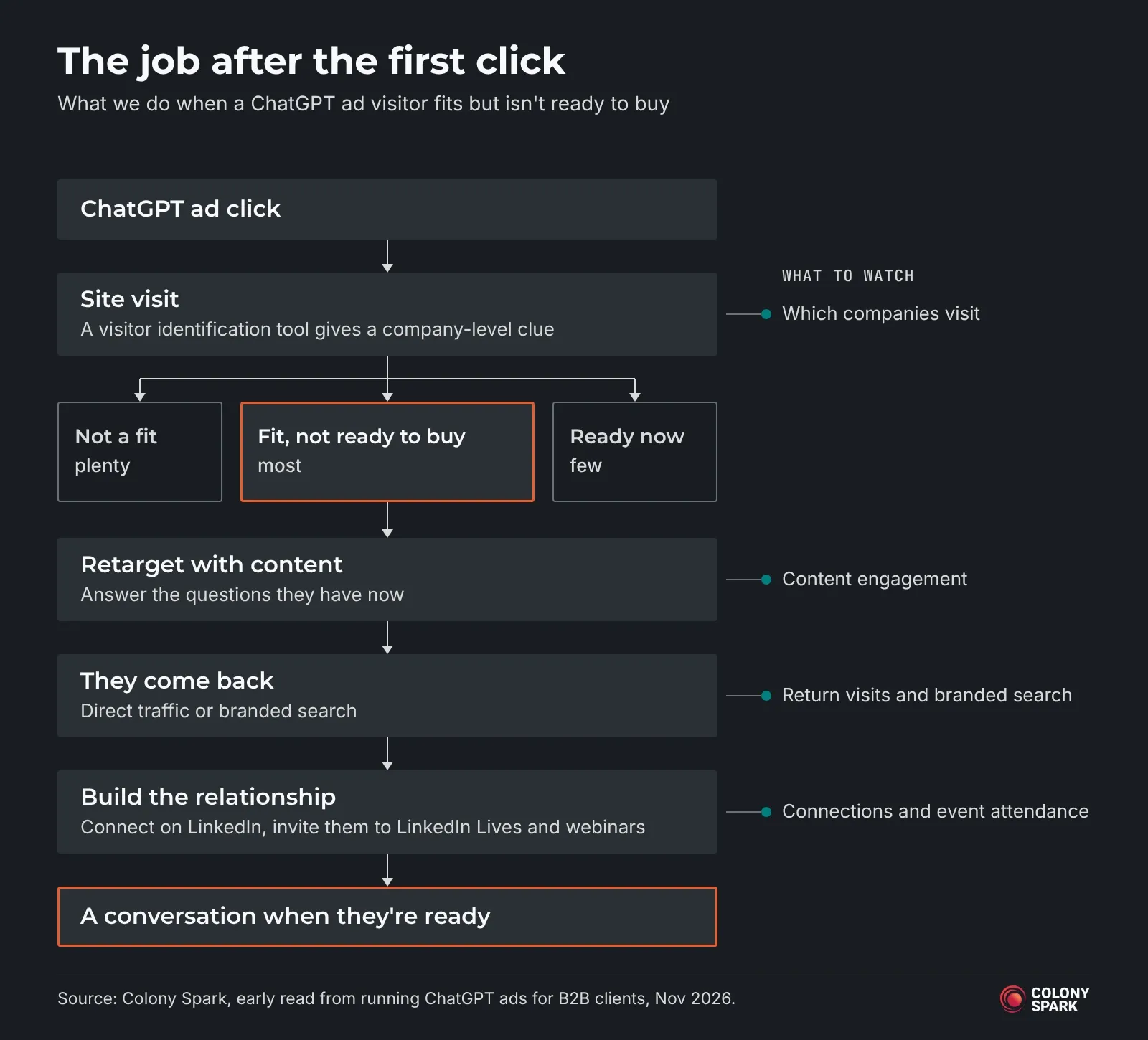
If you follow up with something helpful and stay in touch, you're a name they already know when they start evaluating vendors, which is the familiarity Dawes says buyers prefer. Our go-to-market work for industrial vendors runs on the same kind of follow-up across many touches.
Is the return-visit effect proven for ChatGPT ads?
Nobody has shown it for ChatGPT ads yet, including us.
A randomized study on 500 million Yahoo homepage visits (Lewis and Nguyen, Quantitative Marketing and Economics) found that display ads increased searches for the advertised brand by 30 to 45%. That's consumer display on a different platform, so the effect is plausible but unproven for ChatGPT.
State of Brand warns that "organic" ChatGPT traffic that rises and falls with ad spend is most likely untagged ad clicks rather than a real brand effect.
A genuine return-visit effect looks like delayed visits by name, showing up in branded search or direct traffic days or weeks after the initial click.
That's what we're watching for, and we're still building the measurement that would show it.
Advertising on ChatGPT versus Google and LinkedIn: where does it fit?
ChatGPT ads aren't a replacement for Google search or LinkedIn right now, and probably won't be for a while.
Google search captures people who already know what they want and are comparing providers, and LinkedIn lets you reach specific job titles at specific companies. ChatGPT ads reach people in the middle of working through a question, often before they know what kind of solution they need.
That makes ChatGPT ads closer to an awareness channel than a demand-capture channel.
The CPCs are often lower than Google search (Windmill Strategy saw about a third of their Google search CPCs), but the traffic is earlier in the decision process and converts at a lower rate on first visit.
If you're an ERP consultancy or an MSP and your Google search campaigns are already working, don't redirect that budget. ChatGPT ads are additive. If you have no paid channels running yet, this probably isn't where to start.
What to measure after the first click from ChatGPT ads
Standard last-click reporting will make ChatGPT ads look like a failure for any B2B company with a sales cycle longer than a few weeks.
We track these instead.
| Metric | What it tells you |
|---|---|
| Return visits from the same companies | Whether the initial click created enough interest to bring someone back |
| Direct and branded search traffic | Whether people are searching for your company by name after seeing the ad |
| Content engagement on retargeting | Whether your follow-up content is relevant to the people who clicked |
| LinkedIn connections and event attendance from those accounts | Whether the relationship is progressing beyond anonymous web visits |
| CRM "how did you hear about us" responses | Whether ChatGPT shows up as a touchpoint when deals start |
None of these metrics will give you a clean, single-channel ROI number, so look for patterns across accounts rather than proof from any one click.
What to set up before you test ChatGPT ads for B2B
Running ChatGPT ads without the right infrastructure is a waste of money.
You'll generate clicks and have no way to learn anything from them, so set these up first.
- UTM tags on every ad URL. Without them, ChatGPT traffic gets lumped into direct or referral and you can't separate it from anything else.
- A visitor identification tool, so you can see which companies visit and whether they match your target accounts.
- Content worth coming back for. If someone lands on a page with nothing else to explore, there's no reason to return, so you need articles or case studies on the questions your buyers are working through.
- A retargeting channel outside ChatGPT. ChatGPT's own remarketing audiences needed at least 25,000 matched users during one agency's test, and we'd expect a niche industrial site to fall short of that. Use LinkedIn or Google Display for retargeting instead.
- A follow-up process. When visitor identification shows a target account on your site, someone needs to act on it with a LinkedIn connection request or a relevant piece of content.
Are ChatGPT ads worth it? When to test and when to skip
When a test makes sense
Consider testing if you already run paid campaigns on Google or LinkedIn that cover your demand-capture needs, you have content that answers real buyer questions, and you have the infrastructure described above.
A small budget over 6 to 8 weeks can teach you whether the traffic quality matches your target accounts and whether return visits materialize.
If your average deal size is large enough that one or two additional opportunities per year would justify the spend, the economics can work even with low first-visit conversion rates. For an ERP consultancy whose engagements run to six figures, the math looks very different than it does for a SaaS subscription.
When to skip or stop
Don't start if you have no content to retarget with. An ad click with no follow-up is just an expense.
Don't start without a way to identify which companies visit your site either, since without it you can't tell whether the traffic matches your target accounts.
Stop if after 6 to 8 weeks you see no target-account companies in the visitor data and no return visits. That tells you either the targeting isn't reaching the right people or your content isn't giving them a reason to come back.
Stop if the tracking gap is too large. If OpenAI reports significantly more clicks than your analytics show (as one agency reported to MediaPost), you can't trust your own data enough to learn from it.
What six weeks of ChatGPT ads tell us so far
ChatGPT ads are a new channel with little B2B data and no proven return-visit effect, and the first-click numbers are poor next to established channels. Tracking is still unreliable too, and our six weeks are an early read.
The job after that first click is clearer to us now. Give the right people a reason to come back, help them with the questions they have now, and stay familiar while they figure out what they need.
That's the same job as any awareness channel in a long-cycle B2B sale. The question is whether ChatGPT delivers it efficiently enough to justify the budget.
If you have content worth coming back for and a way to see which companies visit, run a test. Track return visits and branded search instead of same-session conversions, give it 6 to 8 weeks on a modest budget, and then decide whether the pattern justifies spending more.
For industrial vendors selling to manufacturers and distributors, deals take months and several people weigh in. A click only matters if it turns into a relationship.
About the author
Bill Murphy founded Colony Spark in 2018 and leads every client engagement. He plans and runs marketing for companies that sell to manufacturers and distributors, and he publishes The Operations Brief, a weekly briefing for the industrial economy with more than 41,000 subscribers. The ChatGPT ads observations in this article come from campaigns his team runs for clients. Every outside figure was checked against its source on November 5, 2026.
Frequently asked questions
How should I structure landing pages for ChatGPT ad traffic?
Send clicks to pages that match the exact question behind the prompt, then offer a logical next step such as a related guide or comparison page. Don't push for a sales action on the first visit.
What kinds of offers work best for early-stage ChatGPT ad visitors?
Choose low-friction offers that help someone make sense of a problem, like a short assessment or buyer checklist. Save high-commitment offers like demos for visitors who return or show stronger intent signals.
How do I align ChatGPT ad messaging with the prompts people are likely to use?
Build your ad themes around the problems buyers are trying to solve, not product names, then mirror that language on your landing page. Reviewing common sales-call questions and support tickets is often a faster input than brainstorming keywords from scratch.
What is a practical way to evaluate lead quality from ChatGPT ads without relying on form fills?
Define a short list of qualifying behaviors, such as viewing multiple solution pages or returning within a set period, then track how often those behaviors occur among target accounts. Use these signals to decide whether the test is worth continuing.
How should sales teams follow up when ChatGPT ads drive anonymous traffic from target accounts?
Keep it light. Connect on LinkedIn or invite the account to an educational event, and hold the sales conversation until they ask for one.
What compliance or privacy considerations should B2B marketers review before running ChatGPT ads?
Confirm your tracking and data practices match your privacy policy and consent requirements, especially if you use visitor identification or enrichment tools. In regulated industries, bring in legal or compliance early. They can confirm what data you can collect and how you can use it.
How can I test whether ChatGPT ads are influencing pipeline without over-attributing credit?
Compare periods or regions with ads to similar ones without, then look for directional changes in downstream signals like brand search volume and account engagement. Treat your results as evidence to guide budget decisions rather than as a precise single-channel ROI number.
Figure out if ChatGPT ads fit your business
If you sell to manufacturers or distributors and you're weighing whether ChatGPT ads belong in your marketing mix, a 15-minute conversation can help you sort it out. Book a strategy call with Bill Murphy to identify your highest-impact marketing priority and walk away with written action items.