
The claim that MQLs are dead isn’t a hot take anymore. It’s an operational reality for any B2B company where deals take six months or longer to close. When your sales cycle stretches to 130, 180, or even 210+ days, and every purchase decision involves a committee of six to ten stakeholders, a metric designed for high-volume SaaS transactions doesn’t just underperform. It actively misleads your team.
The disconnect between marketing-qualified leads and actual revenue has been widening for years. In one ERP consultancy we diagnosed, about 44% of MQLs became SQLs for three straight quarters, and the win rate on decided deals was still 11% (6 of 55). A healthy MQL number said nothing about where deals were dying. For companies selling complex solutions to traditional industries, the damage compounds: longer cycles mean more wasted effort per bad lead, and committee-driven buying means individual lead scores miss the full picture entirely. This article breaks down why account engagement scoring replaces MQLs and how to build a progression framework that actually predicts revenue.

Why MQLs Are Dead in Long-Cycle B2B
The MQL was invented for a world of individual buyers making relatively quick, low-stakes decisions. A prospect downloads a whitepaper, hits a lead score threshold, and gets routed to a sales rep. That model assumes linear behavior: awareness, interest, consideration, decision. Done.
B2B buying in complex industries doesn’t work that way. Purchases are committee decisions. A CFO evaluates risk. An operations director assesses implementation complexity. A department head champions the solution internally. These stakeholders loop back, bring in new evaluators, and shift priorities based on internal politics and budget cycles. No single lead score captures this reality.
The Three Structural Failures of MQLs
First, MQLs measure individuals when your buyer is a group. Tracking one contact’s engagement tells you nothing about whether the broader buying committee is aligned or even aware of your solution. A “qualified” lead who downloaded three assets might be a junior researcher with zero purchasing authority.
Second, MQLs reward activity that doesn’t predict revenue. Form fills, email opens, and content downloads generate points in traditional lead scoring, but none of these behaviors reliably correlate with purchase intent for high-consideration solutions. Forrester’s research reinforces this point, finding that isolated MQL tallies obscure true buying-committee engagement across lengthy, multi-stakeholder journeys.
Third, MQLs create “handoff hell.” Marketing generates leads and throws them over the wall to sales. Sales says the leads are garbage. Marketing points to volume metrics. Nobody owns the actual business outcome, which is closed revenue. This cycle repeats quarterly, and pipeline stays unpredictable.
Account Engagement Scoring Replaces the Dead MQL
If individual lead scoring fails because B2B buying is a team sport, the fix is straightforward in concept: score accounts, not people. Account engagement scoring aggregates signals across every stakeholder at a target company and measures collective buying behavior instead of individual content consumption.
This shift changes everything about how you identify opportunity. Instead of asking “did this person hit a score threshold?” you ask “is this company showing coordinated buying behavior across multiple decision-makers?” The second question predicts pipeline. The first one predicts nothing useful.
How Account Engagement Scoring Works in Practice
Effective account engagement scoring weighs behaviors at the company level, combining three signal categories into a composite score.
- Firmographic and technographic fit: Does the company match your ideal customer profile based on revenue, industry, tech stack, and organizational structure? This establishes baseline qualification before any engagement occurs.
- Multi-stakeholder engagement signals: Are multiple people at the account visiting your website, opening emails, engaging with LinkedIn content, or attending webinars? Two stakeholders viewing your pricing page in the same week carries far more weight than one person downloading five whitepapers.
- Intent and timing indicators: Are engagement signals accelerating? An account that goes from occasional website visits to three stakeholders viewing solution pages within a ten-day window has shifted from passive awareness to active research.
When these signals converge, you’ve identified what practitioners call a “Hot Account,” one showing coordinated buying behavior that replaces manual BANT qualification entirely. You already know they fit your ICP, you’ve mapped the buying group, and their behavior confirms they’re in-market. No interrogation required.
MarketBetter documented this shift in their own operations, replacing traditional MQL tracking with intent-based account engagement scoring. The result was $2 million in attributable pipeline per campaign and the ability to redeploy budget within 24 hours toward in-market accounts. MQL counts never delivered that kind of operational clarity.
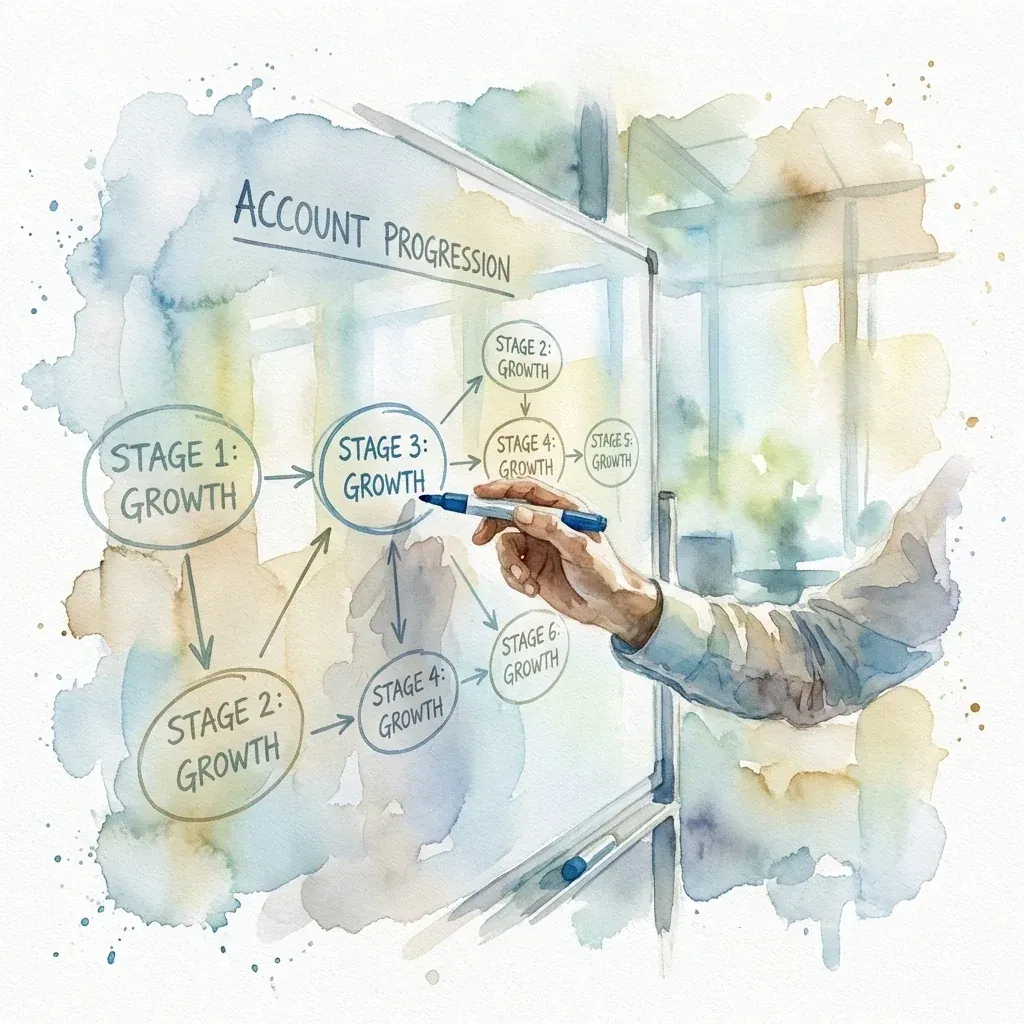
The Account Progression Framework: MQLs Are Dead, Long Live Stages
Account engagement scoring tells you which companies deserve attention. Account progression stages tell you where each company sits in its buying journey and what to do next. Together, they form a complete replacement for the traditional marketing funnel.
The account progression framework replaces the linear lead funnel with eight distinct stages that reflect how B2B purchases actually happen:
| Stage | Definition | What Triggers Progression |
|---|---|---|
| Target Account | Company fits ICP, buying group identified | Enrichment confirms fit and stakeholder mapping completes |
| Aware Account | Buying group members know who you are | Ad impressions, paid engagement or content subscriptions from 2+ contacts within 30 days |
| Engaged Account | Multiple buying group members showing activity | Website visits, email opens, LinkedIn views across stakeholders |
| Hot Account | Intent signals firing, active research behavior | Engagement spike across multiple stakeholders simultaneously |
| Active Conversation | Human dialogue with buying group member | Email reply, call booked, or meeting held |
| Qualified Opportunity | Deal confirmed real and moving forward | Discovery completed, stakeholders aligned, timeline discussed |
| Proposal/Evaluation | Active evaluation underway | Proposal sent, negotiation in progress |
| Closed Won | Signed contract | Revenue recognized |
Notice what’s missing: there’s no MQL stage. No arbitrary score threshold that triggers a handoff. Instead, progression depends on observable account behavior that marketing and sales jointly track. This eliminates the blame game because both teams watch the same accounts move through the same stages.
Three Metrics That Replace MQL Reporting
When MQLs are dead, executives still need answers about marketing effectiveness. Three metrics provide those answers with far greater accuracy.
Pipeline Velocity measures how fast revenue flows through your system: (Opportunities × Average Deal Size × Win Rate) ÷ Sales Cycle Length. Improving any single lever compounds results across the formula. This one number tells leadership more than a thousand MQL reports ever could.
Stage Conversion Rates reveal exactly where deals stall or die. If accounts move easily from Target to Engaged but stall between Hot and Active Conversation, you have a timing or outreach problem, not a lead quality problem. This precision makes resource allocation surgical rather than speculative.
Pipeline Coverage Ratio answers the most critical question: are we on track? Calculated as Total Qualified Pipeline ÷ Revenue Target, healthy B2B companies with long sales cycles maintain 3x to 5x coverage. If you need $500K in new revenue and your win rate is 25%, you need $2M in qualified pipeline. This number provides early warning months before a shortfall hits your P&L.
Measured’s research into advanced marketing measurement validates this multi-metric approach, demonstrating that triangulated measurement produces resilient growth strategies that continuously optimize spend far beyond what single-source MQL metrics deliver.
Building Your Post-MQL Revenue Architecture
Accepting that MQLs are dead is the easy part. Building the replacement system requires deliberate infrastructure changes. Colony Spark builds this replacement with clients, so the team reports on account progression and pipeline instead of lead counts.
The foundation starts with ICP validation and buying group mapping. You identify your 50 to 100 best-fit target accounts, map the six to ten stakeholders involved in each purchase decision, and configure your CRM for account-based tracking rather than lead-based stages. This structural shift, from tracking individuals to tracking companies, changes every downstream workflow.
Next comes signal infrastructure. Website visitor identification tools, multi-stakeholder engagement tracking, and intent data feeds replace form-fill dependency. When three stakeholders at a target account visit your solution pages in the same week, your system flags that account as Hot, and your team acts immediately. No lead score. No routing delay. No handoff friction.
Getting Sales to Trust the New System
The biggest implementation risk isn’t technical. It’s adoption. Sales teams accustomed to receiving MQL lists need proof that account engagement scoring delivers better conversations. The fastest path to buy-in is showing your sales leader the difference between a “qualified lead” who downloaded a whitepaper six months ago and a Hot Account where three decision-makers visited your pricing page this week. The contrast sells itself.
Start with a 30-day parallel run. Keep MQL tracking active while simultaneously monitoring account progression stages. At the end of the month, compare which system better predicted the deals that actually moved forward. The comparison gives your sales team evidence instead of a pitch.
Stop Measuring Fiction, Start Measuring Revenue
The era of reporting on lead volume to justify marketing budgets is ending. Boards and leadership teams increasingly demand metrics tied to pipeline and revenue, not activity counts that create an illusion of progress. Account engagement scoring and progression stages deliver that connection.
If your marketing team still reports MQLs as a primary KPI and your sales cycles exceed 90 days, you’re measuring the wrong things. As the ERP example above shows, a healthy MQL conversion rate can sit next to an 11% win rate, because the metric itself can’t see the buying committee. Replacing it with account-level intelligence doesn’t just improve reporting. It fundamentally changes how your go-to-market engine operates.
Ready to replace vanity metrics with a system that predicts revenue? Get a free Revenue Messaging Audit from Colony Spark to see how your current positioning stacks up, and start building the account progression framework your pipeline actually needs.
Frequently Asked Questions
Q: When should a company keep using MQLs instead of moving to account-based scoring?
A: MQLs can still be useful when you sell a low-cost, low-risk product with a short buying cycle and a single primary decision-maker. If your team can reliably connect lead scores to closed revenue in your own data, you may not need a full replacement, you may just need better qualification rules.
Q: How do you set up account engagement scoring if you have limited website traffic or a small target market?
A: Use a smaller set of high-signal actions and weight them more heavily, then supplement with outbound-generated signals like meeting attendance, replies, and targeted content consumption. In narrow markets, depth of engagement from the right roles matters more than raw volume.
Q: What are common pitfalls when defining engagement signals for account scoring?
A: Teams often overvalue top-of-funnel activity, treat all pages and clicks equally, or fail to adjust weights by persona. Another common issue is letting scores run without decay, which makes yesterday’s interest look like today’s intent.
Q: How do you prevent account scoring from favoring existing customers or partner companies?
A: Maintain clear account statuses (customer, partner, competitor, excluded) and filter them out of new-pipeline scoring views. You can also apply different scoring models by lifecycle category so expansion behavior does not inflate new business prioritization.
Q: How can marketing and sales agree on what qualifies as an “in-market” account?
A: Co-create a short, written definition that combines fit, stakeholder coverage, and recent high-intent actions, then review examples together each week. Agreement improves when both teams use the same dashboard and can point to specific account timelines instead of debating abstract criteria.
Q: What does a practical weekly operating rhythm look like in a post-MQL system?
A: Many teams run a weekly account review where they triage hot accounts, assign next actions, and clear blockers for stalled accounts. A separate monthly calibration meeting is useful for adjusting scoring weights and refining stage definitions based on what progressed to revenue.
Q: How do you measure content performance without relying on lead volume or form fills?
A: Attribute content to account progression by tracking which assets are consumed by target accounts before stage movement, meetings, or opportunities created. This shifts reporting from “how many downloads” to “which content accelerated the right accounts,” which is more actionable for long sales cycles.