
I think your brand needs to become known for more specific problems as buyers spend more of their research time in ChatGPT, Claude, and Gemini. If you sell ERP implementation, warehouse automation, or another complex industrial solution, I want your expertise showing up when someone asks about a situation you understand well, even before they're looking for a provider.
A buyer who isn't shopping for a solution still has work to do. They might be trying to understand why delivery promises keep slipping, how to handle an order change, or what information sales needs from production. My prediction is that more of those questions will go to AI. That makes the answers, citations, and companies introduced during those conversations important places to build recognition before a purchase is on the agenda.
I expect broad industry and platform questions to favor the bigger companies with more budget, more published material, and stronger brand recognition. If you're a smaller ERP consultancy, "we serve manufacturers" gives you very little to be known for in that environment. I'd choose a more specific audience and explain its problems in enough depth that buyers, and the tools helping them, can understand where your expertise fits.
That's how we're preparing at Colony Spark and what we're advising clients to do. We're using customer research to choose that focus, then building content around the questions those people ask throughout their work and buying decisions. I want the brand to become familiar through useful answers well before someone asks which provider to hire.
Start with the customers you serve best
We're advising clients to start in their CRM and connect those records to the calls, emails, support conversations, and delivery work behind them.
For Colony Spark's own review, industry and company size are useful context. I want to get much deeper into why our customers came to us and why we were a good fit. I'm looking for what was happening before they started searching and what they'd already tried. I want to understand which part of the problem we knew particularly well, and whether we delivered the outcome they wanted.
We're looking for patterns in customers we've served well alongside the accounts that were difficult to deliver for, the deals we lost, and the opportunities that went nowhere. I want to know whether we can solve the problem well, whether the customer values the outcome, and whether the work makes sense for us commercially.
A shared software platform or company size would give me a place to investigate. I'd be more interested in a recurring situation that explains why customers needed us and why our approach worked. If a pattern also appears in accounts where we struggled, I want to understand that before building our positioning around it. If success depended on exceptional effort we couldn't repeat, I'd hesitate to make it our focus.
This is where we're using LLMs in our approach. There's a lot to connect across customer records. We use the model to organize the evidence and suggest commonalities for the team to examine.
Here's how we're organizing that review:
| What we examine | What we want to learn |
|---|---|
| Situation before the purchase | What was happening in the company when the problem became important? |
| Trigger | What changed that made them act? |
| Previous attempts | What had they already tried, and why hadn't it worked? |
| Constraints | What did the solution have to accommodate? |
| Reason for choosing us | What did the buyer actually say, and where is that recorded? |
| Delivery experience | Which parts went well, and where did we struggle? |
| Outcome | What changed for the customer, and what evidence do we have? |
We keep a reference to the source beside each answer. An empty field tells me we need to learn something. I don't want the model filling it with a reasonable-sounding explanation.
Here's a starting prompt you can adapt:
Review these authorized customer records for shared buying situations. Look beyond industry and company size. Identify common triggers, operating constraints, previous attempts, reasons for choosing us, and outcomes. Cite the record behind each observation. Separate the customer's words from the sales team's interpretation. Show missing evidence and cases that contradict each pattern. Suggest candidate audiences for us to review, and explain what we'd still need to learn before choosing one.
Use records your company is permitted to process in the tool you've chosen. Then sit down with the people who sold and delivered the work. Ask them which patterns describe a real advantage, which reflect incomplete records, and which depend on circumstances we can't repeat.
Define the shared situation more precisely
The audience might cross industries, which is an important part of this for me.
Here's a hypothetical ERP customer review to show how I'd make the decision.
| Customer situation | What the review brings together |
|---|---|
| Configurable equipment manufacturer | Sales calls describe delivery dates changing after customers revise an order. Delivery notes show sales and production working from different versions of it. |
| Configurable furniture manufacturer | Emails describe custom options affecting production plans. The buying conversation centers on giving customers a delivery date the team can trust. |
| Assembler of customer-configured components | The team uses spreadsheets to check the effect of order changes before confirming a date. That coordination problem prompted the ERP conversation. |
| Manufacturer seeking basic accounting help | The buyer wants simpler financial reporting. Production planning and order changes barely enter the discussion. |
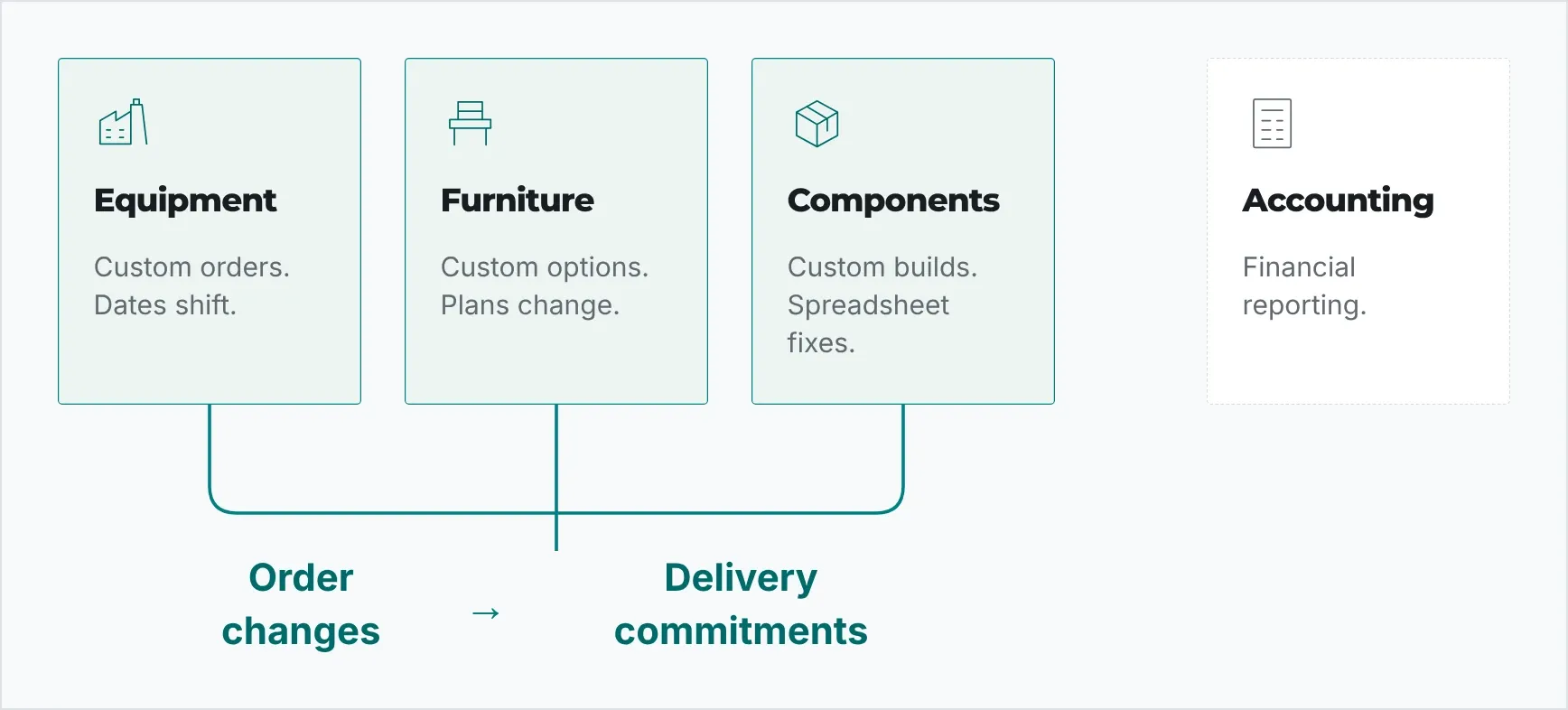 Three customers in different industries share one operating problem. The fourth needs a different kind of help.
I wouldn't choose equipment manufacturers just because the first account was in that industry. The first three situations suggest something more useful: businesses assembling configurable products whose order changes make delivery commitments hard to manage. The accounting customer belongs to the same broad industry but needs a different kind of help.
That gives me a candidate audience. I'd then ask sales and delivery whether we understand that operating problem well enough to build a repeatable approach around it. I'd check whether we can reach enough of those companies and whether solving the problem is important enough for them to invest in. Shared frustration alone wouldn't be enough for me to choose it.
The position I'd test is: "We help businesses making configurable products connect order changes, production planning, and delivery commitments through their ERP."
I can now explain what the consultancy should be known for. I'd build a walkthrough of what happens after an order changes, show where sales and production need the same information, and explain what I'd check before recommending a different system. That lets a buyer see how the consultancy would approach a problem they recognize.
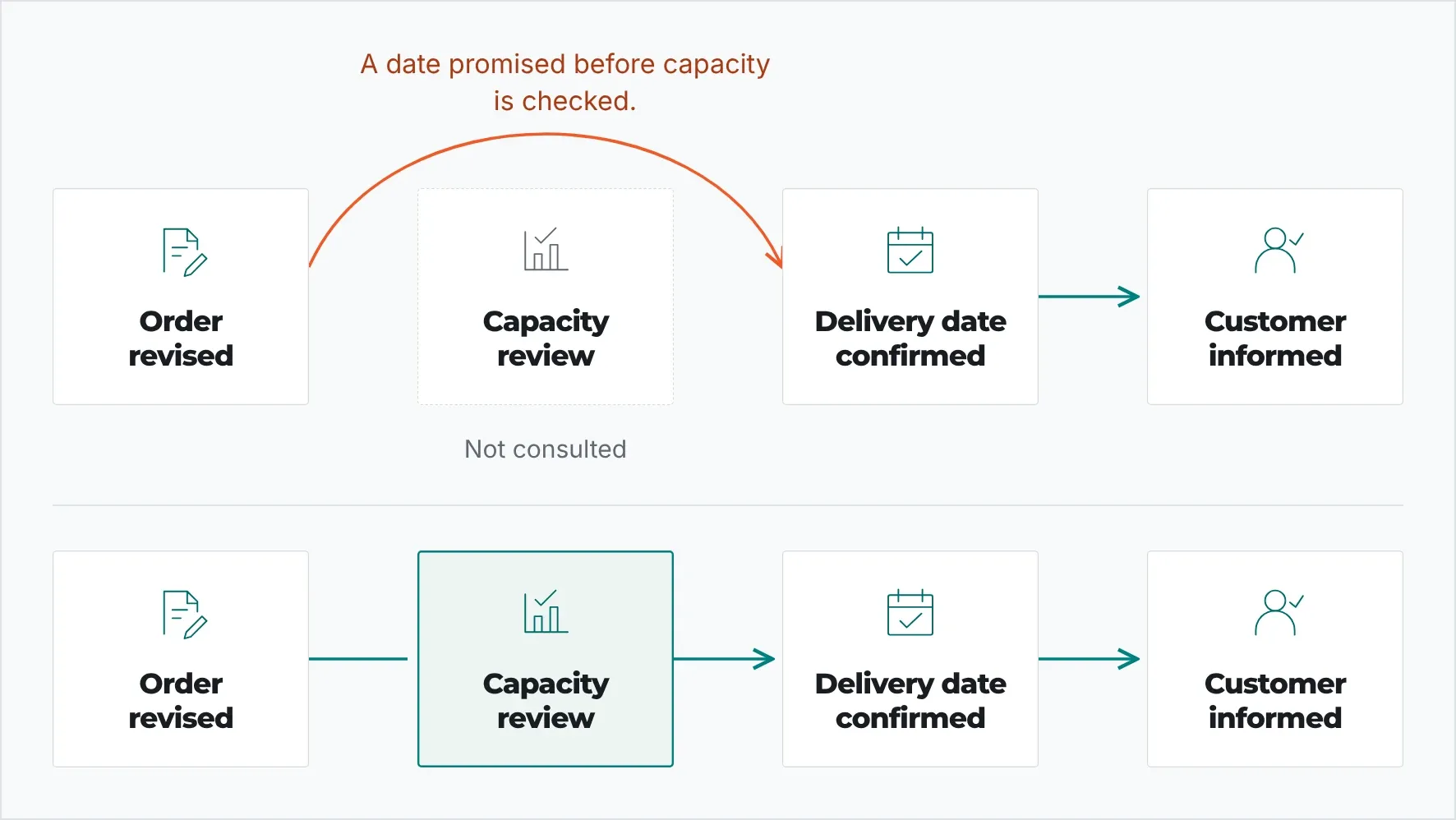 Top: a date promised before capacity is checked. Bottom: capacity review connected to the delivery commitment.
Choose a primary audience without closing every other door
Getting more specific can feel risky when you already serve several kinds of customers. I wouldn't drop a good customer because they fall outside the audience we've chosen to emphasize.
We're choosing where to concentrate the brand, the content, and the effort to reach buyers. Adjacent opportunities can still make sense if we can deliver well. What I want to avoid is allowing every possible opportunity to expand the message until it says very little about anyone.
I'd test the audience before changing the whole business around it. If too few suitable buyers are reachable or the problem doesn't justify a purchase, I'd revisit the choice. If buyers recognize the situation but misunderstand our role, I'd work on the positioning first.
Choose a position and test it with buyers
For the ERP example, I'd put the proposed positioning in front of people dealing with that operating problem. I'd ask them what they think the consultancy helps with, when they would bring it in, and what they would need to see before considering it.
I wouldn't stop at whether they like the wording. If they can't connect it to something happening in their business, I want to know why. We may have described the wrong problem, used language they don't recognize, or assumed a priority they don't share.
Their answers should shape both the message and the proof. If a buyer is concerned about keeping production running through an implementation, a general explanation of ERP features leaves that concern unanswered. I'd want material that shows how we'd evaluate disruption, what decisions need to be made, and where the risks sit.
Check what you're already known for
Part of our preparation is understanding what the brand already shows up for in AI-assisted research. That's a baseline we're advising clients to establish, too.
Start with questions customers actually ask. Include their situation and constraints. For the hypothetical ERP consultancy, I'd test questions at different points in the decision:
We assemble configurable equipment. When a customer changes an order, sales promises a new delivery date before production has checked capacity. Which parts of this process should we investigate first?
We're evaluating ERP implementation help for a configurable-products business. We need order changes, production planning, and delivery commitments to stay connected. What experience should we look for in a partner, and which consultancies should we investigate?
I'd add the buyer's actual location, systems, and project constraints where relevant. I wouldn't include our company name in those questions, because I want to see whether it comes up without prompting. A separate question asking what the tool knows about our company can help us check how it describes us.
Keep the exact question, date, tool, and response. Record whether the brand appears, what the answer says about it, which sources are cited, and whether the company is recommended for the problem described. Repeat the same set over time so you can compare the results.
Include a broad question for comparison. I wouldn't make winning a generic search for an ERP consultant the whole objective. I want to understand whether the brand shows up for the situations we've chosen to serve.
For a site you manage, Bing Webmaster Tools' AI Performance report can show cited pages and grounding queries across its supported AI experiences. Microsoft describes the query data as a sample. It's one way to check what you're already being cited for, alongside the questions you test yourself.
If the answers associate the consultancy with basic accounting work while it's trying to become known for production coordination, that gives me something to investigate. I'd compare the pages and outside sources behind that description with the expertise the consultancy wants to communicate.
These are samples of what the tools returned, so I wouldn't treat one missing mention as a reason to change the audience. I want to see how we're described over time and compare that with what buyers tell us.
Build the brand around the questions that follow
Once the audience and positioning are set, we work through the questions those people ask before they're ready to buy, while they're evaluating options, and when they're trying to make a decision internally.
For the hypothetical consultancy, that could mean explaining why delivery promises become unreliable, how to diagnose the information gap between sales and production, what an implementation partner needs to understand about configurable products, and how to evaluate a proposed migration.
This is where the audience decision changes the brand people encounter. The consultancy's website should describe that operating situation and explain its approach, giving sales a starting point for exploring what the buyer needs. I'd use video to walk through an order change and explain the decisions involved. A community discussion might call for help diagnosing the coordination problem, while the buyer is still working out whether an ERP project would help.
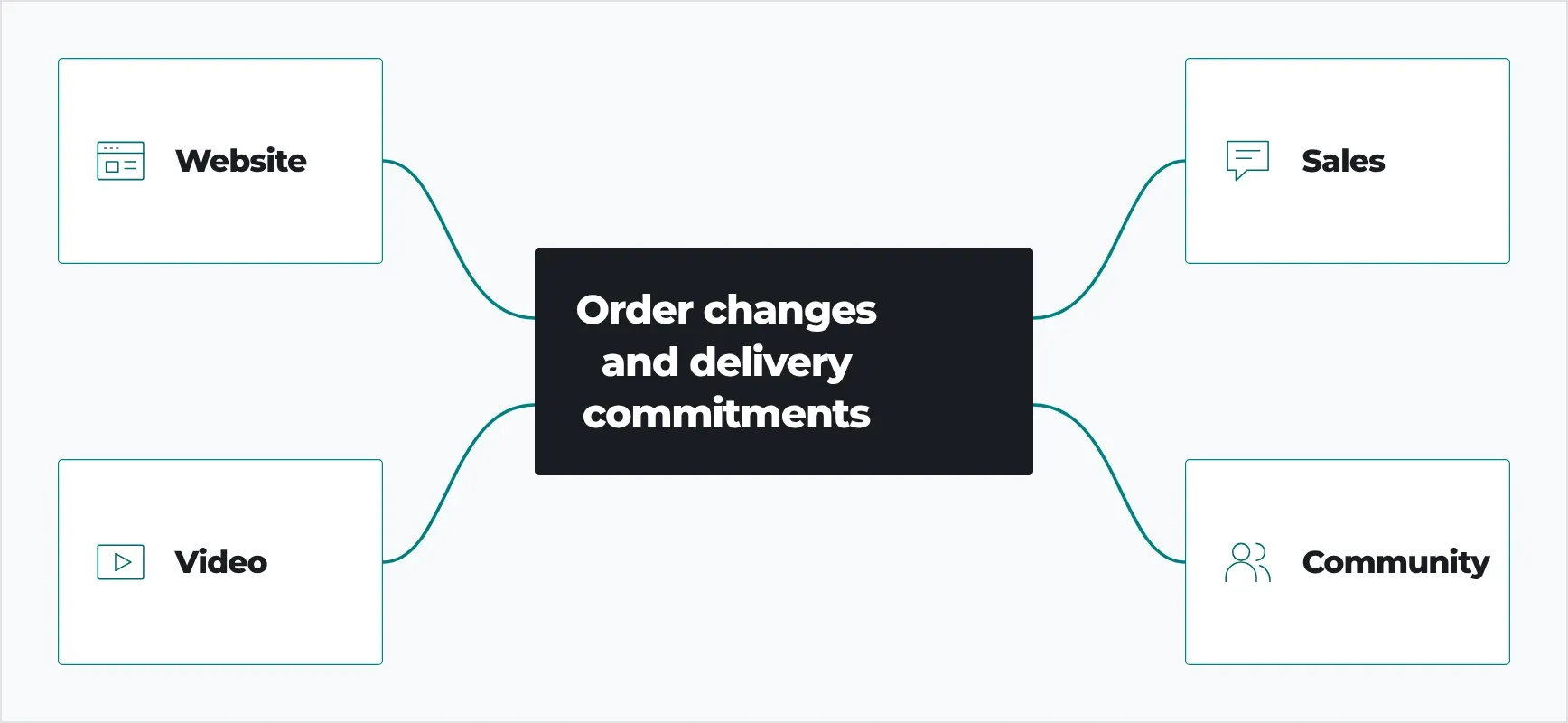 The same problem carried through four places buyers meet the brand.
The subject stays recognizable across those encounters, while each contribution answers a different question. That's how we're approaching brand building: helping the audience repeatedly see how we think about the work they need done. I want them to remember us when that situation becomes a priority.
We're also looking at where the audience spends time and asks for help. Customer conversations can point us toward trade publications, associations, communities, events, and people they pay attention to. That helps us decide where to contribute and what would be useful there.
Being known before the sales conversation matters to this approach. 6sense's buyer research reports that buyers commonly arrive with preferences already formed. It also reports that LLM use hasn't replaced vendor interactions. That fits how we're approaching the brand: give people reasons to recognize our expertise before they need a proposal, and keep making the case when they want to examine it more closely.
Where to start
Bring a group of customer records to your sales and delivery team and choose an audience to test. Write down why that group makes sense, what would make you reconsider it, and the problem you want buyers to associate with your company.
I'd use that to draft a positioning statement and one explanation of how you approach the problem. Put both in front of people dealing with it. Their response gives you something concrete to improve before you commit the rest of your brand work to that audience.
If you want help finding where that audience spends time, request a free audience report.